In one sentence: “A BIPV module certificate alone cannot prove façade fire safety.” Even an electrically safe module behaves entirely differently once installed on a façade, because the air cavity behind the panel, combustible components, and energized heating are all added.
01Why It Matters
A BIPV façade carries three risks at once that ordinary cladding does not.
BIPV (Building-Integrated Photovoltaics) replaces roofing, cladding, curtain wall and fenestration. It isn't "solar bolted onto a building" — it is the building itself. The decisive difference from ordinary cladding is that a BIPV façade holds fuel, ignition source, and chimney in a single space.
① The cavity (air gap) — a hidden chimney
A 50–150 mm air gap sits behind the module for cooling and condensation drainage. In a fire it acts as a chimney, drawing flame vertically along the cabling and up to higher floors — invisibly from outside.
② Energized heating (charged state) — a BIPV-only dimension
PV is energized during daytime, heating module, encapsulant and cabling at once. As we'll see, in FM testing a 4 mm glass module's peak heat-release rate surged 50–60% in the charged state.
③ Glass breakage and combustible encapsulant
When thermal stress breaks the tempered glass, the EVA/POE encapsulant inside releases combustible gas and glass debris falls.
In FM testing, a flexible module certified to UL 1703 Class A recorded 11 MW of heat release and flames over 9 m in an actual façade test (16-ft PPT). A "pass" on a module, bench-scale or roof test does not guarantee façade fire performance.
02Global Trends (2024–2026)
The center of gravity is shifting from "the module" to "the completed façade system."
A 2025 Korean full-scale BIPV façade study reported that a BIPV façade can pose greater risk than ordinary aluminum composite panel (ACP) in peak heat release, total heat release and smoke. An FM-sponsored large façade test likewise found some BIPV systems exceeded the acceptable fire size, and that existing EN 13501 / UL 1703 classifications don't always correlate with large-façade performance. The regulations of several countries have moved fast over the past two years.
US 2024 IBC — new Section 1411
A provision addressing BIPV exterior-wall coverings and fenestration was added. Façade systems are reviewed for assembly fire spread (e.g., NFPA 285) in addition to PV listing.
UL 1703 revision · KS F 8414 confirmed current
UL states the current ANSI framework for PV-module safety is UL 61730-1/-2. Korea's KS F 8414 (façade-system fire test) was confirmed current by notice on 2024-11-01.
FM 4484 published
A new retrofit-coating standard for roof-mounted rigid PV module systems.
ANSI/FM 4411 revision in progress (PINS)
Allowing cladding/WRB/insulation alternates, terminology cleanup, and scope expansion to cavities over 4 in. — directly relevant to façade-BIPV design.
FM: 12 large BIPV façade tests → FM 4483 recommendation
Four glass modules and one flexible module tested by 16-ft PPT. Recommended test methods and pass criteria for a dedicated wall-mounted BIPV standard, FM 4483.
EU CPR 2024/3110 working plan · EN 50583 draft
The EU includes fire safety as a horizontal task in the 2026–2029 CPR working plan. A draft update of the BIPV standard EN 50583 is also under way (though a draft does not itself imply mandatory certification).
03The Two-Layer Certification Structure
BIPV stacks "electrical/module safety (Layer 1)" and "building/fire performance (Layer 2)."
| Layer | Purpose | Key standards | Character |
|---|---|---|---|
| Layer 1 · Electrical/module | Shock, ignition, durability, output | IEC/UL 61730 (safety) · IEC 61215 (performance) · UL 1699B/IEC 63027 (arc) | Universal baseline. Does not include a direct façade fire test |
| Layer 2 · Building/fire | Reaction grade + façade fire-spread control | Reaction EN 13501-1 · façade NFPA 285 · BS 8414 · KS F 8414 · FM 4483 | Varies by jurisdiction. FM 4483 brings a BIPV-façade-specific test |
| ↳ Bridge standards | Define "PV = building product" | IEC 63092-1/-2 · EN 50583-1/-2 | Voluntary — not mandatory product certification. Fire is met separately by each country's law |
"PV module fire classification" and "building façade fire performance" are not the same. A façade BIPV — even with an electrically safe module — performs differently in fire spread because of the rear air cavity, combustible encapsulant, wiring, insulation and mounting cavity.
04Region by Region
The US, EU, UK and Korea each handle "façade BIPV" differently.
United States — UL · NFPA · FM
Roof BIPV has a dedicated path in UL 7103, but this is limited to roof-covering BIPV and excludes wall assemblies, skylights and roof windows. Façade BIPV is approached via PV listings (UL 61730/1703) plus NFPA 285 (fire-spread test for exterior wall assemblies containing combustible components) and 2024 IBC Section 1411. FM uses its own framework (Section 5 below).
Europe — CPR · EN · national tests
Under CPR 305/2011 (→ 2024/3110), CE marking and EN 13501-1 reaction classes (Euroclass A1–F) form the base. But there is no unified full-scale façade test, so member states borrow BS 8414 (UK), DIN 4102-20 (DE), LEPIR2 (FR) and SP FIRE 105 (SE). Under the EPBD, PV integration becomes mandatory for new public/commercial buildings in 2026 and residential in 2029.
UK & Commonwealth — BS 8414 + BR 135
BS 8414 (masonry/steel-frame) is a full-system test of fire breaking out of an opening and climbing the façade; the pass judgement is made under BR 135. After the Grenfell Tower fire, Scotland no longer accepts BS 8414/BR 135 as an A1/A2 alternative for buildings 11 m and taller (from 2022).
Korea — KS F 8414 + the four quality-recognition tests
This is the decisive gate in PYROSOL's actual market (schools, public and medical facilities). KS C 8577 is the BIPV module performance standard, while KS F 8414 (est. 2019, effectively Korea's adoption of BS 8414) is the façade-system fire test. Cladding made of two or more materials must prepare the four quality-recognition tests as a package.
- KS F 8414 — full-scale façade (no Level-2 point may exceed 600 ℃ for 30 s within 15 min)
- KS F ISO 5660-1 — cone calorimeter (limited-combustibility: THR over 10 min ≤ 8 MJ/㎡)
- KS F 2271 — gas toxicity (mean mouse incapacitation time ≥ 9 min)
- KS F ISO 13784-1 — sandwich-panel room-corner test
If all constituent materials are non-combustible, the room-corner and full-scale tests (KS F ISO 13784-1, KS F 8414) are exempt. But if an intumescent material is included, the assembly is classed as a "composite," the exemption is voided, and the full-scale test becomes mandatory. (One round of the four tests costs roughly KRW 50 million — per MOLIT notice.)
05FM Deep-Dive — From 4411 to 4483
FM is currently the leading body demonstrating and standardizing BIPV façade fire performance.
FM defines a BIPV façade as a "cavity wall." So the parent standard for BIPV façade testing is ANSI/FM 4411 (Cavity Wall Systems, 2020), and the new FM 4483 adds BIPV-specific criteria on top. FM 4411 was created — against the backdrop of successive cladding fires in Dubai, Grenfell and La Crosse — to evaluate "combustibility inside the cavity."
The two test methods
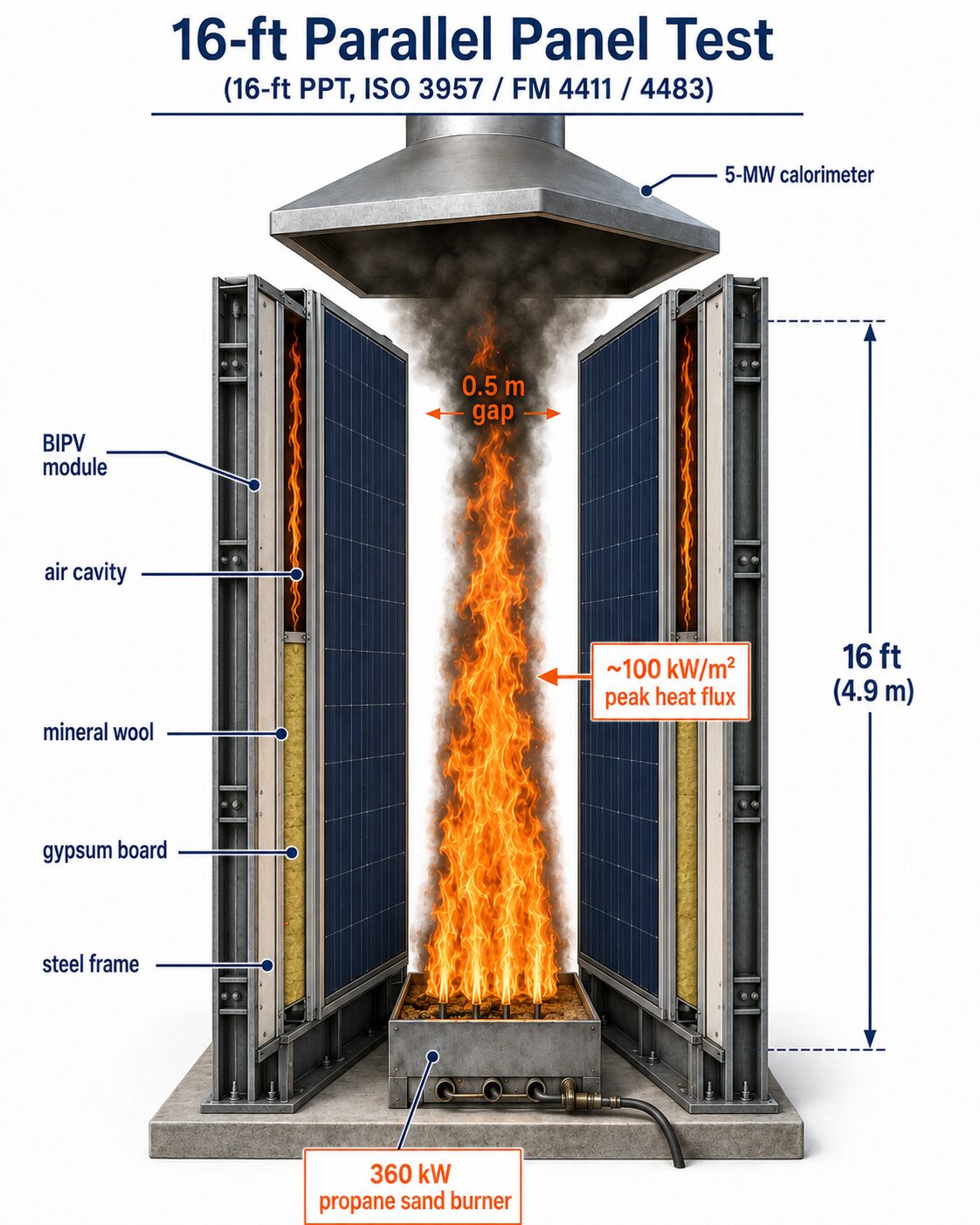
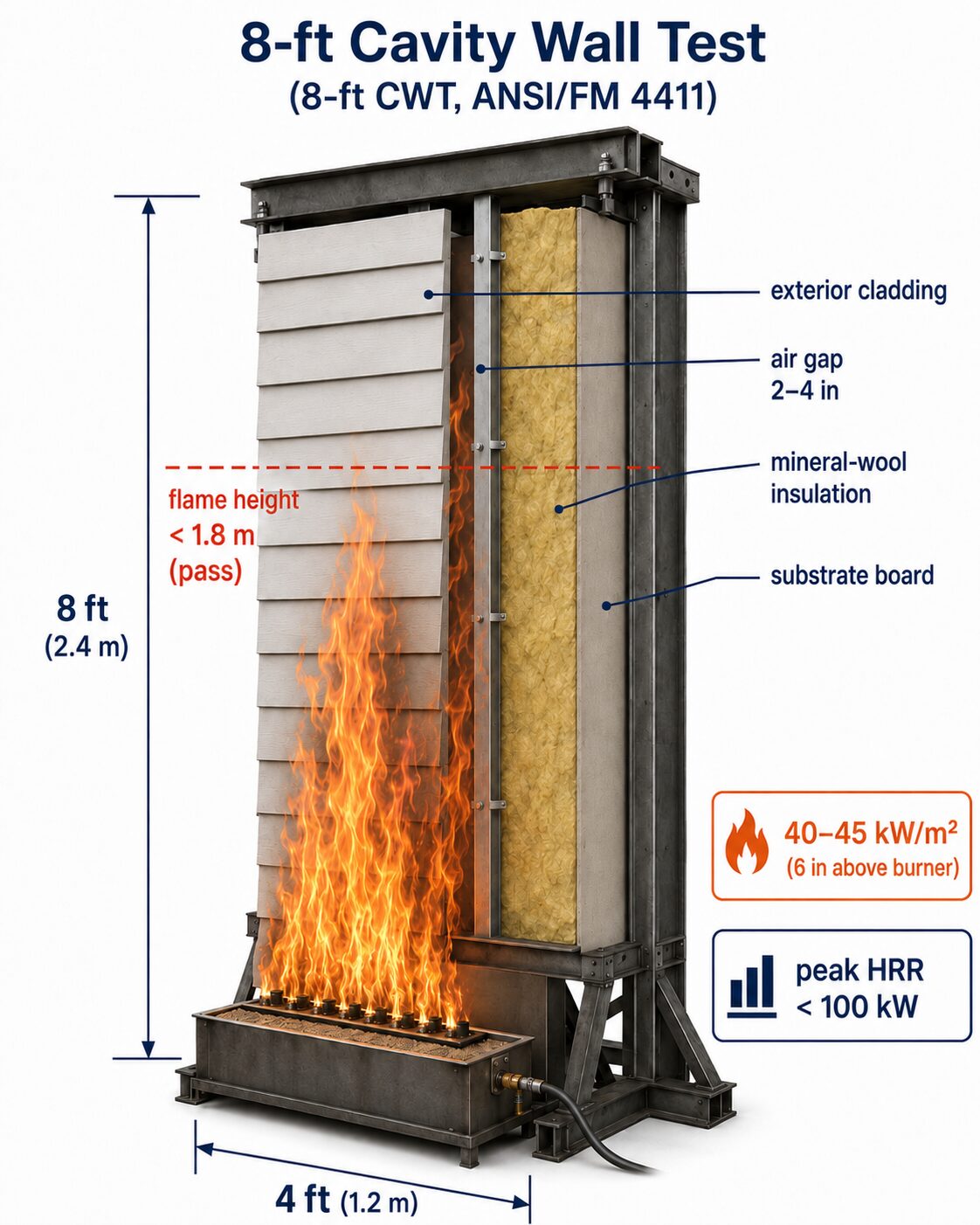
The 16-ft PPT (parallel panel, 4.9 m tall) applies ~100 kW/㎡ with a 360 kW propane burner to simulate an external fire and measures peak HRR over 15 minutes. The 8-ft CWT (cavity wall, 2.4 m tall) simulates electrical/welding/spark ignition inside the cavity.
The four-stage fire spread (glass modules)
The 16-ft PPT of glass-glass BIPV consistently progressed as ① glass breakage → ② cavity chimney spread → ③ external venting → ④ module fall. Under 100 kW/㎡ thermal stress, 4 mm glass breaks within 1–2 minutes; flame rises along the cabling at ~25 cm/s, vents through horizontal joints, and as adhesive degrades modules detach — oxygen and fuel surge and HRR spikes.
The data — what decided a pass
The 16-ft PPT pass line is peak HRR ≤ 830 kW (unlimited height). Of seven glass modules, only γ-6mm (6 mm thick glass + cavity restrictors every 2 ft) passed; the flexible module failed overwhelmingly at 11 MW.
| Module (state) | Peak HRR | Result | Notes |
|---|---|---|---|
| γ-6mm (uncharged, OC) | 780 kW | PASS ✓ | 6 mm glass + 2-ft cavity restrictors — the only pass |
| γ-6mm (charged, MP) | 850 kW | 50-ft limit | 6 mm barely affected by charging |
| β-3mm (uncharged, OC) | 1,150 kW | fail | 0.2 mm encapsulant (low fuel) |
| α-4mm (uncharged, OC) | 1,400 kW | fail | 0.6 mm encapsulant |
| γ-4mm (uncharged, OC) | 1,600 kW | fail | 0.9 mm encapsulant (high fuel) |
| α-4mm (charged, MP) | 2,300 kW | fail | +50–60% when charged |
| γ-4mm (charged, MP) | 2,450 kW | fail | preheating accelerates glass breakage |
| Flexible module (FlexPV) | 11,000 kW | fail | UL 1703 Class A, yet 11 MW |
Three design factors governed the outcome.
- Glass thickness — 4 mm breaks in 1–2 min; 6 mm delays to ~6.5 min → delaying encapsulant release and spread.
- Cavity restrictor — the decisive factor. γ-6mm compartments the cavity every 2 ft to block the chimney, passing alone at the lowest 780 kW.
- Encapsulant thickness (fuel) — HRR scales with it: 0.9 mm > 0.6 mm > 0.2 mm.
4 mm glass surged 50–60% in peak HRR when charged (MP), as preheating accelerates glass breakage, while 6 mm glass showed little difference (high heat capacity). FM conservatively recommends uncharged (OC) testing.
FM 4483 proposed pass criteria (glass module + cavity, 16-ft PPT, uncharged)
- Peak HRR ≤ 830 kW (unlimited height) / 830–1,100 kW (50-ft, 15 m limit)
- Cavity temperature at 12 ft ≤ 473 K (200 °C)
- Top 4 ft (1.2 m) modules undamaged — no cracking or breakage
All three must be met for approval; if insulation/substrate is combustible, the 8-ft CWT is added. In the 8-ft CWT, all glass modules showed no spread (propane wasn't strong enough to break the tempered glass) — FM recommends exempting glass-glass modules from the 8-ft CWT.
FM 4483 is not "pass if HRR is low." You must block the cavity (≤ 200 °C) and preserve the top modules (undamaged). Phase II is now evaluating active/passive solutions — cavity barriers, cable protection, vertical separation.
06Pass Criteria at a Glance
Each standard measures "what, and how far is allowed" differently — FM uses heat-release rate (HRR); Korea/UK use temperature; NFPA uses observation + temperature.
| Test (standard) | Measures | Pass criteria |
|---|---|---|
| FM 16-ft PPT (4411·4483·4880) | Peak HRR | ≤ 830 kW (unlimited) / 830–1,100 kW (50 ft) / >1,100 kW fail |
| FM 8-ft CWT (4411·4483) | HRR + flame height | HRR ≤ 100 kW + flame height < 6 ft (1.8 m) |
| FM 4483 additions (BIPV-specific) | Cavity temp + module | 12-ft cavity ≤ 200 ℃ + top 4-ft modules undamaged |
| KS F 8414 (Korea) | Level-2 temperature | No Level-2 (5 m above opening) point may exceed 600 ℃ for 30 s within 15 min |
| BS 8414 / BR 135 (UK) | Level-2 temperature | Same as KS F 8414 (which adopted it) — external 600 ℃/30 s limit |
| NFPA 285 (US) | Observation + temperature | Meet vertical/lateral flame-spread and temperature limits over 30 min (assembly basis) |
FM judges by heat-release rate (kW); Korea and the UK by temperature (600 ℃ / 30 s / Level 2). KS F 8414 is a direct adoption of BS 8414/BR 135, so their data transfers directly — but FM (HRR-based) measures different quantities entirely.
07What It Means for PYROSOL
FM's top conclusion — "compartment and block the cavity and you pass" — aligns exactly with PYROSOL's design logic.
The secret of the only module to pass FM's tests, γ-6mm, was the cavity restrictor. PYROSOL's core design — ventilated in normal use, actively foaming to seal the cavity in a fire — is precisely the common solution that targets both FM 4483 criterion ② (cavity ≤ 200 °C) and Korea's KS F 8414 (Level-2 600 ℃/30 s).
| FM finding | PYROSOL direction |
|---|---|
| Cavity restrictor is the key to passing (γ-6mm) | Active expansion = dynamic cavity barrier. Ventilated/drained in normal use, sealed in a fire — reconciling compartmentation and ventilation |
| Thick glass (6 mm) reduces breakage and HRR | Consider increasing superstrate thickness (directly reducing breakage and debris risk) |
| Encapsulant fuel scales with HRR | Select low-fuel / flame-retardant encapsulant |
| Top-module integrity required | Glass thermal-shock resistance + heat-resistant frame/adhesive design |
| Charged 4 mm glass +50–60% HRR | If using thin glass, recognize energized preheating risk — offset with thickness and compartmentation |
① Domestic (mandatory) — the four quality-recognition tests, especially KS F 8414 + limited-combustibility. ② FM track (optional) — FM 4483 16-ft PPT (≤ 830 kW) + cavity ≤ 200 ℃ + top modules undamaged. The measurement methods differ, but active cavity sealing is the common solution that targets both.
08Sources & Caveats
- [Primary] G. Agarwal, FM — "Fire Performance Evaluation of Building Integrated Photovoltaic (BIPV) Façade Systems," 2025.11, FM Public Release, Project RW000606. (FM 4483 recommendation, ANSI/FM 4411 16-ft PPT·8-ft CWT, 12 large-scale tests, Table 7-1)
- ANSI/FM 4411-2020 — Cavity Wall Systems; ANSI/FM 4880·4881 — Class 1 Insulated Panels / Exterior Wall Systems; FM 4476/4478/4484 — Roof PV (FM Approvals).
- IEA-PVPS Task 15 — Fire Safety of BIPV (2023); IEC 63092-1/-2 (2020), EN 50583-1/-2.
- IEC 61730-1/-2 (2023), UL 61730 / UL 1703 / UL 790 / UL 7103 / ASTM E108.
- NFPA 285 (2025) / 2024 IBC Section 1411; EN 13501-1/-5, CEN/TS 1187 (CPR 305/2011 → 2024/3110); EPBD.
- BS 8414-1/-2 (2020), BR 135, BS 9414 (UK); post-Grenfell Scotland rules.
- Korea — KS C 8577; KS F 8414 (KATS notice 2019-0599); MOLIT notice 2023-24 (Building Material Quality Recognition & Management Criteria); Criteria for Flame-Retardant Performance & Fire-Spread Prevention of Building Finishing Materials.
- BIPV façade fire research — RISE (Norway), USTC (China), SP FIRE 105 (Sweden), and others.